
What Do Cobots Actually Do in Manufacturing? Real Applications on the Shop Floor
If you’re exploring automation, one question usually comes up early:
Where would a cobot actually fit in our operation?
It’s a fair question.
Many manufacturers understand the concept of collaborative robots, but what matters most is how they’re used in real production environments. Not in theory, but in day-to-day operations.
This article walks through common cobot applications in manufacturing and shows where they make a practical impact.
What Is a Cobot?
A collaborative robot, or cobot, is a robotic system designed to operate safely alongside people in a shared workspace.
Unlike traditional industrial robots, cobots are built for flexibility and ease of use. They can typically be deployed without extensive guarding and are often programmed through simple interfaces.
In real terms, cobots are used to:
- Automate repetitive production tasks
- Improve consistency and throughput
- Support operators in physically demanding roles
They are not meant to replace your team. They are used to optimize how work is distributed across your operation.
Common Cobot Applications in Manufacturing
Most successful cobot implementations focus on tasks that are repetitive, consistent, and easy to define.
Below are some of the most common ways cobots are being used across industrial environments.
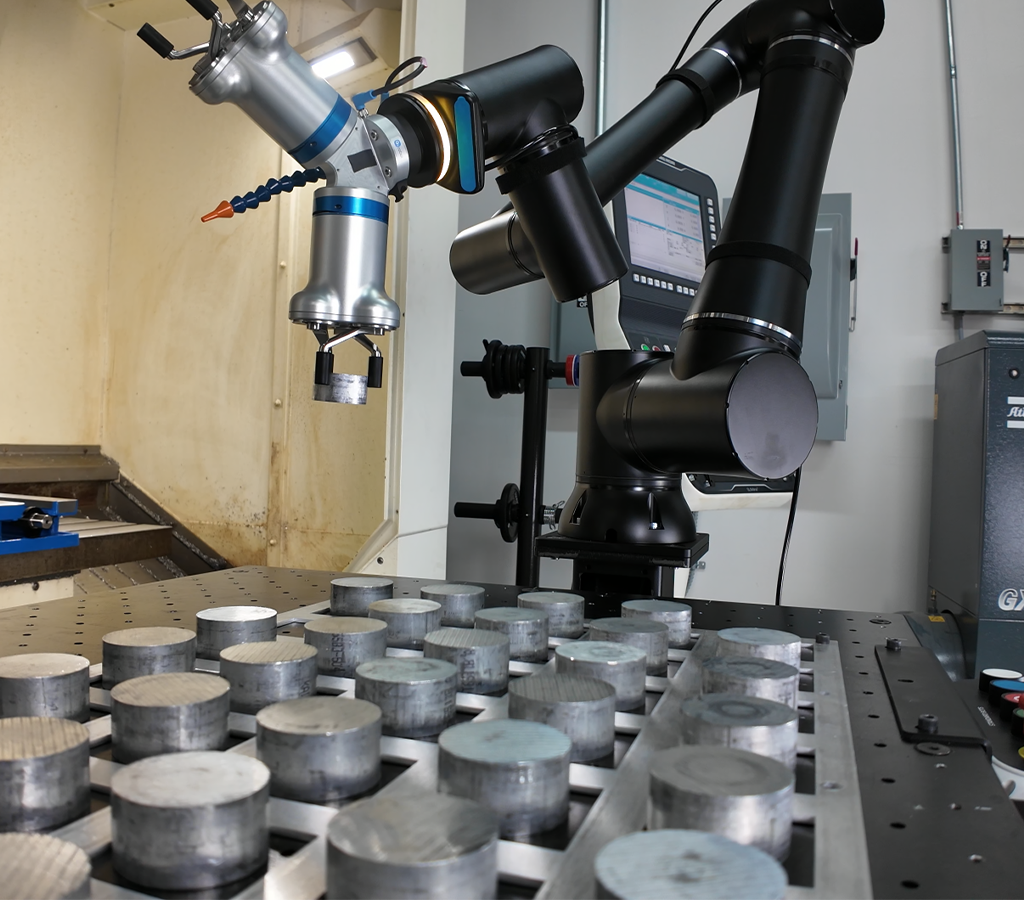
Machine Tending
Typical environment: CNC machining, injection molding, metal fabrication
Application:
Cobots load and unload parts, interact with machines, and handle materials between cycles.
Impact:
- Increased machine uptime
- Reduced manual intervention
- Operators freed up for setup and programming
Pick and Place Operations
Typical environment: assembly lines, packaging, sorting
Application:
Cobots transfer parts between stations, conveyors, trays, or packaging areas.
Impact:
- Faster, more consistent cycle times
- Reduced handling errors
- Improved process flow between stations
Palletizing and End-of-Line Handling
Typical environment: packaging lines, distribution, manufacturing
Application:
Cobots stack products onto pallets with consistent positioning and repeatability.
Impact:
- Reduced physical strain on operators
- Improved consistency in pallet builds
- More reliable output across shifts
Assembly Assistance
Typical environment: electronics, automotive, consumer goods
Application:
Cobots assist with fastening, inserting components, applying adhesives, or repetitive assembly steps.
Impact:
- Consistent force and torque application
- Reduced variability in assembly quality
- Less operator fatigue
Welding Support and Repetitive Fabrication Tasks
Typical environment: metalworking, fabrication shops
Application:
Cobots handle repetitive weld paths or prep tasks, supporting skilled welders.
Impact:
- Increased throughput
- More efficient use of skilled labor
- Improved consistency in repetitive welds
Inspection and Quality Control
Typical environment: electronics, medical manufacturing, food production
Application:
Cobots equipped with vision systems perform inspections, verify alignment, and detect defects.
Impact:
- More consistent quality checks
- Reduced reliance on manual inspection
- Improved traceability of results
What Makes a Task a Good Fit for a Cobot?
Across all these applications, the most effective use cases share a few key traits:
- The task follows a repeatable process
- The steps remain consistent from cycle to cycle
- The work is physically repetitive or undesirable
- The role is difficult to staff consistently
- The task creates a bottleneck in production
These are often the areas where automation delivers the fastest and most noticeable improvements.
What Changes After Implementation
When a cobot is applied to the right task, the impact is typically operational, not just technical.
Manufacturers often see:
- More consistent production output
- Reduced dependency on manual labor for repetitive tasks
- Lower physical strain on employees
- Greater flexibility when production demands shift
Cobots can also be redeployed to different applications, allowing teams to adapt as needs change.
A Typical Day for a Cobot
In a standard production shift, a cobot operates as part of the workflow rather than replacing it.
It handles repetitive cycles continuously, maintains a consistent pace, and supports production through breaks and shift changes.
At the same time, operators are able to:
- Oversee multiple processes
- Focus on quality and process improvement
- Spend less time on repetitive manual tasks
Where to Start with Cobot Automation
For most manufacturers, the best place to begin is not a full automation strategy. It is a single task.
Start with:
- The most repetitive process on your floor
- A role that consistently slows production
- A position that is difficult to fill or retain
From there, additional opportunities typically become easier to identify.
Final Thoughts
Cobots are not limited to large-scale automation environments.
They are being used every day in small and mid-sized facilities to improve efficiency, stabilize production, and support existing teams.
In most cases, the opportunity is already there. It just needs to be identified.
Explore Cobot Solutions for Your Operation
If you’re evaluating where cobots could fit into your process, a structured approach makes all the difference.
At AutomaTech, we work with manufacturers to identify practical automation opportunities, define application requirements, and support implementation from concept through deployment.